


- Treat emergency printing playbook for teams as a spec-and-approval decision, not just a price lookup.
- Use a reviewed PDF and one clear owner to reduce rework on emergency printing playbook for teams.
- Match shipping speed to the real in-hands date so rush and same-day printing jobs do not absorb unnecessary rush cost.
- Ask for line-item clarity on quantity, stock, sides, finishing, and timing before you compare quotes.
- Keep only the templates, guides, and approval steps that actually speed repeat work.
A useful hub for emergency printing playbook for teams should do three things well: point to the right starting template, show how to clean it up before export, and make approvals repeatable for operations teams needing an urgent print playbook.
This guide focuses on practical decisions, not hype. You will see how specs drive price, where mistakes usually appear, and how to request quotes that map cleanly to production for your situation.
A strong resource hub should help teams start faster, clean files more confidently, and approve the final version with less confusion. If it only adds links without improving decisions, it is not doing enough.
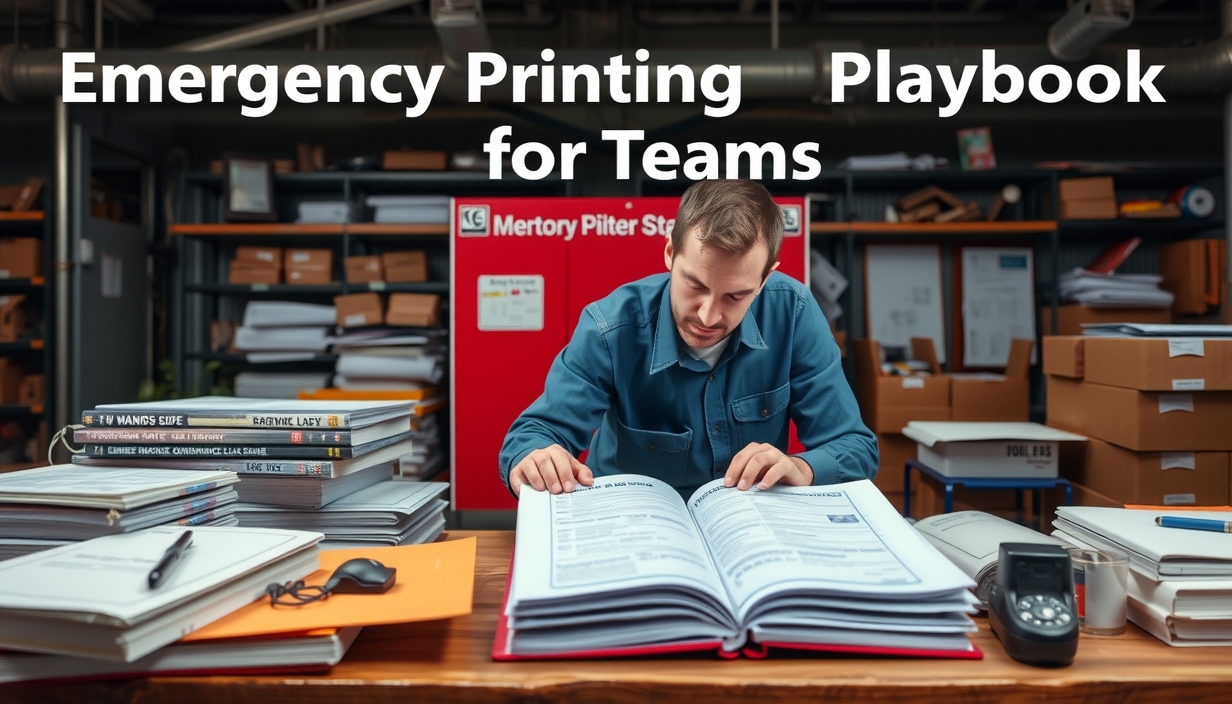
What belongs in a practical resource stack for emergency printing playbook for teams
A resource stack for emergency printing playbook for teams should answer three questions quickly: where to start, how to clean the file, and who approves it before anything gets printed.
Keep the resource list lean. The best hubs point to the few files, examples, and review steps people actually use, not every possible asset in the system.
Use design review to solve readability and print-safety issues, not to restart the whole project. A hub works best when templates, cleanup, and approval each have a clear place.
Templates save time when they fit the format and the use case. They create rework when teams force the wrong template into a job just because it is already available.

How to use templates, guides, and review help for emergency printing playbook for teams
Templates, guideline files, and design review help each solve a different problem in emergency printing playbook for teams. Use templates for speed, guidelines for technical safety, and live review when the layout still feels unstable.
Guideline files are most useful at the beginning, before layout choices harden. They are less helpful when a messy file is already deep into revision cycles.
Archive only the resources that continue to produce clean output. Old templates, outdated versions, and half-approved layouts create clutter faster than they create speed.
A strong resource hub should help teams start faster, clean files more confidently, and approve the final version with less confusion. If it only adds links without improving decisions, it is not doing enough.

Planning anchors for emergency printing playbook for teams
Internal rush-order planning shows that splitting only the truly urgent pages is one of the strongest budget controls. Shipping upgrades and compressed production together create most avoidable rush premiums.
Use design review to solve readability and print-safety issues, not to restart the whole project. A hub works best when templates, cleanup, and approval each have a clear place.
Templates save time when they fit the format and the use case. They create rework when teams force the wrong template into a job just because it is already available.
Keep the resource list lean. The best hubs point to the few files, examples, and review steps people actually use, not every possible asset in the system.
Resource stack map
| Resource | What it solves | Best time to use it | Common misuse |
|---|---|---|---|
| Guideline templates | Faster page setup and safer margins | Before layout starts | Treating them as final art without cleanup |
| Template examples | Quicker format decisions | While choosing size or orientation | Copying format without checking print specs |
| Design review support | Fixes clarity and production risks | Before final export | Using support after multiple conflicting approvals |

Planning estimator
Use this for scenario planning before you lock a quote. Values are illustrative, not binding.
Cleanup and approval habits for emergency printing playbook for teams
Cleanup matters because old layers, hidden backgrounds, stale fonts, and unlabeled versions make emergency printing playbook for teams look more finished than it really is. Small cleanup steps save expensive confusion later.
Archive only the resources that continue to produce clean output. Old templates, outdated versions, and half-approved layouts create clutter faster than they create speed.
A strong resource hub should help teams start faster, clean files more confidently, and approve the final version with less confusion. If it only adds links without improving decisions, it is not doing enough.
Guideline files are most useful at the beginning, before layout choices harden. They are less helpful when a messy file is already deep into revision cycles.

Next steps for repeatable ordering for emergency printing playbook for teams
Approval is where emergency printing playbook for teams either becomes predictable or becomes risky. Ask the last few questions before signing off, not after the quote has already been routed into production.
Archive only the resources that continue to produce clean output. Old templates, outdated versions, and half-approved layouts create clutter faster than they create speed.
A strong resource hub should help teams start faster, clean files more confidently, and approve the final version with less confusion. If it only adds links without improving decisions, it is not doing enough.
Guideline files are most useful at the beginning, before layout choices harden. They are less helpful when a messy file is already deep into revision cycles.
- Freeze the final approved PDF before quoting or rerunning.
- State quantity, stock, sides, finishing, and deadline in one place.
- Confirm destination ZIP and actual in-hands timing before choosing shipping.
- Use a small proof or sample whenever readability or finishing is high-stakes.
- Archive the approved spec so the next order is easier to repeat.

Current savings path (expires end of 2026)
A qualifying discount path is active through the end of 2026 for eligible copy-style orders. Mention it during quote intake and include full specs so support can confirm whether the order profile qualifies.
Use it as a planning advantage, not a guess: the cleanest savings come when the file is final, the spec is stable, and the shipping method matches the real deadline.
More color copy pages from the full catalog
Specialty printing for the industries below. Each page includes live pricing, paper options, and free design setup.
-
 250 Entry-level 11x17 · 100lb · Gloss Cover Rv Park Manager
Gloss cover stock gives a polished, professional finish.
View pricing & options →
250 Entry-level 11x17 · 100lb · Gloss Cover Rv Park Manager
Gloss cover stock gives a polished, professional finish.
View pricing & options →
-
 500 Fast 4.25x5.5 · 80lb · Matte Cover Safety Inspector
Matte cover stock for a clean, writable surface.
View pricing & options →
500 Fast 4.25x5.5 · 80lb · Matte Cover Safety Inspector
Matte cover stock for a clean, writable surface.
View pricing & options →
-
 1000 Quick 5.5x8.5 · 100lb · Matte Cover Sailmaker
Matte cover stock for a clean, writable surface.
View pricing & options →
1000 Quick 5.5x8.5 · 100lb · Matte Cover Sailmaker
Matte cover stock for a clean, writable surface.
View pricing & options →
-
 2500 Rapid 8.5x11 · synthetic · Waterproof Scaffolder
Waterproof or tearproof stock — ideal for high-traffic handouts.
View pricing & options →
2500 Rapid 8.5x11 · synthetic · Waterproof Scaffolder
Waterproof or tearproof stock — ideal for high-traffic handouts.
View pricing & options →
-
 5000 Express 8.5x14 · synthetic · Tearproof Scrap Metal Recycler
Waterproof or tearproof stock — ideal for high-traffic handouts.
View pricing & options →
5000 Express 8.5x14 · synthetic · Tearproof Scrap Metal Recycler
Waterproof or tearproof stock — ideal for high-traffic handouts.
View pricing & options →
-
 100 Urgent 11x17 · 20lb · Bond Scrum Master
Standard bond stock — reliable for everyday document runs.
View pricing & options →
100 Urgent 11x17 · 20lb · Bond Scrum Master
Standard bond stock — reliable for everyday document runs.
View pricing & options →
-
 250 Speedy 4.25x5.5 · 24lb · Bond Sculptor
Standard bond stock — reliable for everyday document runs.
View pricing & options →
250 Speedy 4.25x5.5 · 24lb · Bond Sculptor
Standard bond stock — reliable for everyday document runs.
View pricing & options →
-
 500 Rush 5.5x8.5 · 28lb · Bond Seamstress
Heavier bond stock for documents that need to last.
View pricing & options →
500 Rush 5.5x8.5 · 28lb · Bond Seamstress
Heavier bond stock for documents that need to last.
View pricing & options →
-
 1000 Swift 8.5x11 · 32lb · Bond Search Engine Evaluator
Heavier bond stock for documents that need to last.
View pricing & options →
1000 Swift 8.5x11 · 32lb · Bond Search Engine Evaluator
Heavier bond stock for documents that need to last.
View pricing & options →
-
 2500 Prompt 8.5x14 · 20lb · Recycled Septic Tank Servicer
Recycled bond stock — eco-friendly and cost-effective.
View pricing & options →
2500 Prompt 8.5x14 · 20lb · Recycled Septic Tank Servicer
Recycled bond stock — eco-friendly and cost-effective.
View pricing & options →
-
 5000 Accelerated 11x17 · 24lb · Recycled Shoe Cobbler
Recycled bond stock — eco-friendly and cost-effective.
View pricing & options →
5000 Accelerated 11x17 · 24lb · Recycled Shoe Cobbler
Recycled bond stock — eco-friendly and cost-effective.
View pricing & options →
-
 100 Cheap 4.25x5.5 · 32lb · Recycled Sign Painter Pinstriper
Recycled bond stock — eco-friendly and cost-effective.
View pricing & options →
100 Cheap 4.25x5.5 · 32lb · Recycled Sign Painter Pinstriper
Recycled bond stock — eco-friendly and cost-effective.
View pricing & options →
-
 250 Affordable 5.5x8.5 · 60lb · Text Soap Maker
Standard bond stock — reliable for everyday document runs.
View pricing & options →
250 Affordable 5.5x8.5 · 60lb · Text Soap Maker
Standard bond stock — reliable for everyday document runs.
View pricing & options →
-
 500 Economical 8.5x11 · 70lb · Text Social Media Influencer
Standard bond stock — reliable for everyday document runs.
View pricing & options →
500 Economical 8.5x11 · 70lb · Text Social Media Influencer
Standard bond stock — reliable for everyday document runs.
View pricing & options →
-
 1000 Low-cost 8.5x14 · 80lb · Text Social Worker
Solid 80lb stock balances quality and affordability.
View pricing & options →
1000 Low-cost 8.5x14 · 80lb · Text Social Worker
Solid 80lb stock balances quality and affordability.
View pricing & options →
Glossary
- Preflight: a final check on file dimensions, fonts, margins, and resolution before production.
- Duplex: printing on both sides of the sheet.
- Stock: the paper type, finish, and weight selected for the job.
- Turnaround: the production window before shipping or pickup.
- Line-item quote: pricing broken into the decisions that actually change the total.
How to use this guide
Use this page to lock specs, compare options, and move into quoting with fewer surprises. It is written for operations teams needing an urgent print playbook and focuses on the decisions that change print results, turnaround, and total cost.
Relevant links and next steps
- Color and black-and-white copies
- Request a quote
- Free pre-press and design help
- Track an order
- Guideline templates for print-safe setup
- Bulk flyer templates and format ideas
- Related: Same Day Printing What Is Realistic
- Related: How to Prevent Delays in Fast Print Jobs
- Related: Rush Order File Checklist
- Related: Pickup vs Delivery for Tight Deadlines
- Related: Free Design Help for Better Printed Documents
- Related: How to Use Templates for Fast Document Printing
Authoritative references
Lock specs and request pricingHelpful templates and guideline files
Use these internal resources to move faster without losing print-safe structure.
- Letterhead templates and stationery options
- Letterhead overview and branded paper options
- Guideline template library for print-safe setup
- Copies setup guide and ordering hub
- 9x12 boutique flyer layout reference
- 3.5x8.5 narrow handout reference
- 4.25x5.5 compact flyer reference
- 6x9 promotional sheet reference
- 8x10 information sheet reference
FAQ (12)
1) What should a useful resource hub include first?
Start with the constraint that matters most to operations teams needing an urgent print playbook: final use, deadline, readability, or budget. That first decision usually makes the rest of the order easier to judge. A strong resource hub should help teams start faster, clean files more confidently, and approve the final version with less confusion. If it only adds links without improving decisions, it is not doing enough. Guideline files are most useful at the beginning, before layout choices harden. They are less helpful when a messy file is already deep into revision cycles. Archive only the resources that continue to produce clean output. Old templates, outdated versions, and half-approved layouts create clutter faster than they create speed. Archive the approved PDF and final spec after the job closes. That one habit makes the next order faster, easier to compare, and less likely to drift.
2) How do I know whether a template really helps?
The best answer usually appears once you separate what is fixed from what is optional. For operations teams needing an urgent print playbook, that means deciding which specs are non-negotiable before discussing upgrades. Archive only the resources that continue to produce clean output. Old templates, outdated versions, and half-approved layouts create clutter faster than they create speed. A strong resource hub should help teams start faster, clean files more confidently, and approve the final version with less confusion. If it only adds links without improving decisions, it is not doing enough. Guideline files are most useful at the beginning, before layout choices harden. They are less helpful when a messy file is already deep into revision cycles. If the job is urgent, separate truly time-sensitive pages from everything else. That gives support more room to protect both budget and quality.
3) Which resource saves the most time early in the process?
Treat this as an approval question, not just a technical one. The right answer depends on who will use the piece, how fast it is needed, and what would make a rerun painful. Guideline files are most useful at the beginning, before layout choices harden. They are less helpful when a messy file is already deep into revision cycles. Archive only the resources that continue to produce clean output. Old templates, outdated versions, and half-approved layouts create clutter faster than they create speed. A strong resource hub should help teams start faster, clean files more confidently, and approve the final version with less confusion. If it only adds links without improving decisions, it is not doing enough. If you need support, send one message with the approved PDF, quantity, stock preference, finishing needs, and in-hands date so quoting stays practical instead of speculative.
4) How should teams organize links, templates, and approvals?
A practical answer starts with the actual job, not with generic advice. Match the file, deadline, handling, and audience before you lock any assumption in place. A strong resource hub should help teams start faster, clean files more confidently, and approve the final version with less confusion. If it only adds links without improving decisions, it is not doing enough. Guideline files are most useful at the beginning, before layout choices harden. They are less helpful when a messy file is already deep into revision cycles. Archive only the resources that continue to produce clean output. Old templates, outdated versions, and half-approved layouts create clutter faster than they create speed. When in doubt, ask for a quick pre-press review before the job scales. Early clarity is almost always cheaper than fixing a rushed assumption later.
5) What should I review before reusing an older asset?
Start with the constraint that matters most to operations teams needing an urgent print playbook: final use, deadline, readability, or budget. That first decision usually makes the rest of the order easier to judge. Archive only the resources that continue to produce clean output. Old templates, outdated versions, and half-approved layouts create clutter faster than they create speed. A strong resource hub should help teams start faster, clean files more confidently, and approve the final version with less confusion. If it only adds links without improving decisions, it is not doing enough. Guideline files are most useful at the beginning, before layout choices harden. They are less helpful when a messy file is already deep into revision cycles. Archive the approved PDF and final spec after the job closes. That one habit makes the next order faster, easier to compare, and less likely to drift.
6) When does design help beat another template?
The best answer usually appears once you separate what is fixed from what is optional. For operations teams needing an urgent print playbook, that means deciding which specs are non-negotiable before discussing upgrades. Guideline files are most useful at the beginning, before layout choices harden. They are less helpful when a messy file is already deep into revision cycles. Archive only the resources that continue to produce clean output. Old templates, outdated versions, and half-approved layouts create clutter faster than they create speed. A strong resource hub should help teams start faster, clean files more confidently, and approve the final version with less confusion. If it only adds links without improving decisions, it is not doing enough. If the job is urgent, separate truly time-sensitive pages from everything else. That gives support more room to protect both budget and quality.
7) How do I keep a shared resource library practical?
Treat this as an approval question, not just a technical one. The right answer depends on who will use the piece, how fast it is needed, and what would make a rerun painful. A strong resource hub should help teams start faster, clean files more confidently, and approve the final version with less confusion. If it only adds links without improving decisions, it is not doing enough. Guideline files are most useful at the beginning, before layout choices harden. They are less helpful when a messy file is already deep into revision cycles. Archive only the resources that continue to produce clean output. Old templates, outdated versions, and half-approved layouts create clutter faster than they create speed. If you need support, send one message with the approved PDF, quantity, stock preference, finishing needs, and in-hands date so quoting stays practical instead of speculative.
8) What proofing step belongs between download and print?
A practical answer starts with the actual job, not with generic advice. Match the file, deadline, handling, and audience before you lock any assumption in place. Archive only the resources that continue to produce clean output. Old templates, outdated versions, and half-approved layouts create clutter faster than they create speed. A strong resource hub should help teams start faster, clean files more confidently, and approve the final version with less confusion. If it only adds links without improving decisions, it is not doing enough. Guideline files are most useful at the beginning, before layout choices harden. They are less helpful when a messy file is already deep into revision cycles. When in doubt, ask for a quick pre-press review before the job scales. Early clarity is almost always cheaper than fixing a rushed assumption later.
9) Which supporting links matter most for repeat work?
Start with the constraint that matters most to operations teams needing an urgent print playbook: final use, deadline, readability, or budget. That first decision usually makes the rest of the order easier to judge. Guideline files are most useful at the beginning, before layout choices harden. They are less helpful when a messy file is already deep into revision cycles. Archive only the resources that continue to produce clean output. Old templates, outdated versions, and half-approved layouts create clutter faster than they create speed. A strong resource hub should help teams start faster, clean files more confidently, and approve the final version with less confusion. If it only adds links without improving decisions, it is not doing enough. Archive the approved PDF and final spec after the job closes. That one habit makes the next order faster, easier to compare, and less likely to drift.
10) How do I keep a resource hub from becoming clutter?
The best answer usually appears once you separate what is fixed from what is optional. For operations teams needing an urgent print playbook, that means deciding which specs are non-negotiable before discussing upgrades. A strong resource hub should help teams start faster, clean files more confidently, and approve the final version with less confusion. If it only adds links without improving decisions, it is not doing enough. Guideline files are most useful at the beginning, before layout choices harden. They are less helpful when a messy file is already deep into revision cycles. Archive only the resources that continue to produce clean output. Old templates, outdated versions, and half-approved layouts create clutter faster than they create speed. If the job is urgent, separate truly time-sensitive pages from everything else. That gives support more room to protect both budget and quality.
11) What file naming rule helps the most?
Treat this as an approval question, not just a technical one. The right answer depends on who will use the piece, how fast it is needed, and what would make a rerun painful. Archive only the resources that continue to produce clean output. Old templates, outdated versions, and half-approved layouts create clutter faster than they create speed. A strong resource hub should help teams start faster, clean files more confidently, and approve the final version with less confusion. If it only adds links without improving decisions, it is not doing enough. Guideline files are most useful at the beginning, before layout choices harden. They are less helpful when a messy file is already deep into revision cycles. If you need support, send one message with the approved PDF, quantity, stock preference, finishing needs, and in-hands date so quoting stays practical instead of speculative.
12) How do I turn the hub into a repeatable team workflow?
A practical answer starts with the actual job, not with generic advice. Match the file, deadline, handling, and audience before you lock any assumption in place. Guideline files are most useful at the beginning, before layout choices harden. They are less helpful when a messy file is already deep into revision cycles. Archive only the resources that continue to produce clean output. Old templates, outdated versions, and half-approved layouts create clutter faster than they create speed. A strong resource hub should help teams start faster, clean files more confidently, and approve the final version with less confusion. If it only adds links without improving decisions, it is not doing enough. When in doubt, ask for a quick pre-press review before the job scales. Early clarity is almost always cheaper than fixing a rushed assumption later.