

The term “paper” in the context of professional printing encompasses a remarkably diverse range of materials — each with different fiber compositions, surface treatments, weight specifications, and optical characteristics that produce meaningfully different results when CMYK ink is applied to them. For marketing flyer printing specifically, understanding these distinctions ensures that the material you choose amplifies your design rather than working against it.
This guide is organized as a practical encyclopedia of the paper types available for marketing flyer production, with each type’s characteristics, appropriate use cases, and limitations explained in full detail.
The Complete Marketing Flyer Paper Encyclopedia
The dominant choice for professional marketing flyers globally. A smooth mineral coating is applied to both sides of the paper, sealing the fiber surface to prevent ink absorption. CMYK ink sits on the surface, producing maximum color saturation and sharpness. UV top coat further enhances reflectivity and adds fingerprint and moisture resistance. This is the paper used for restaurant flyers, event promotions, retail campaigns, real estate listings, and the vast majority of professional marketing distribution.
Best for: Any image-heavy or color-dominant marketing flyer design. The universal professional standard.
Identical weight to 100lb Gloss Book but with no surface coating, allowing the paper’s fiber texture to remain tactilely accessible. Colors print softer and more muted due to minor ink absorption. Text legibility is significantly improved under reflective office lighting because there is no glare. The preferred paper type for law firms, financial services, medical practices, academic institutions, and any corporate context where reading comfort outweighs visual vibrancy. Also the correct choice for any flyer that includes a writable section (forms, coupons, coupon codes).
Best for: Corporate, legal, medical, financial, and educational marketing flyers.
The economy tier of professional printing — lighter than 100lb but still coated for acceptable color reproduction. At 120gsm, 80lb Gloss feels similar to a standard magazine inner page. This lightness makes it the correct choice for maximum-volume campaigns where unit cost is the primary concern. Door-drop distributors, event handbills at large festivals, insert programs for newspapers or product packaging, and any scenario where thousands of flyers must be produced within a tight budget. Quality is still acceptable for most promotional contexts — just lighter in feel.
Best for: High-volume door drops, newspaper inserts, event handbills (2,500+ units).
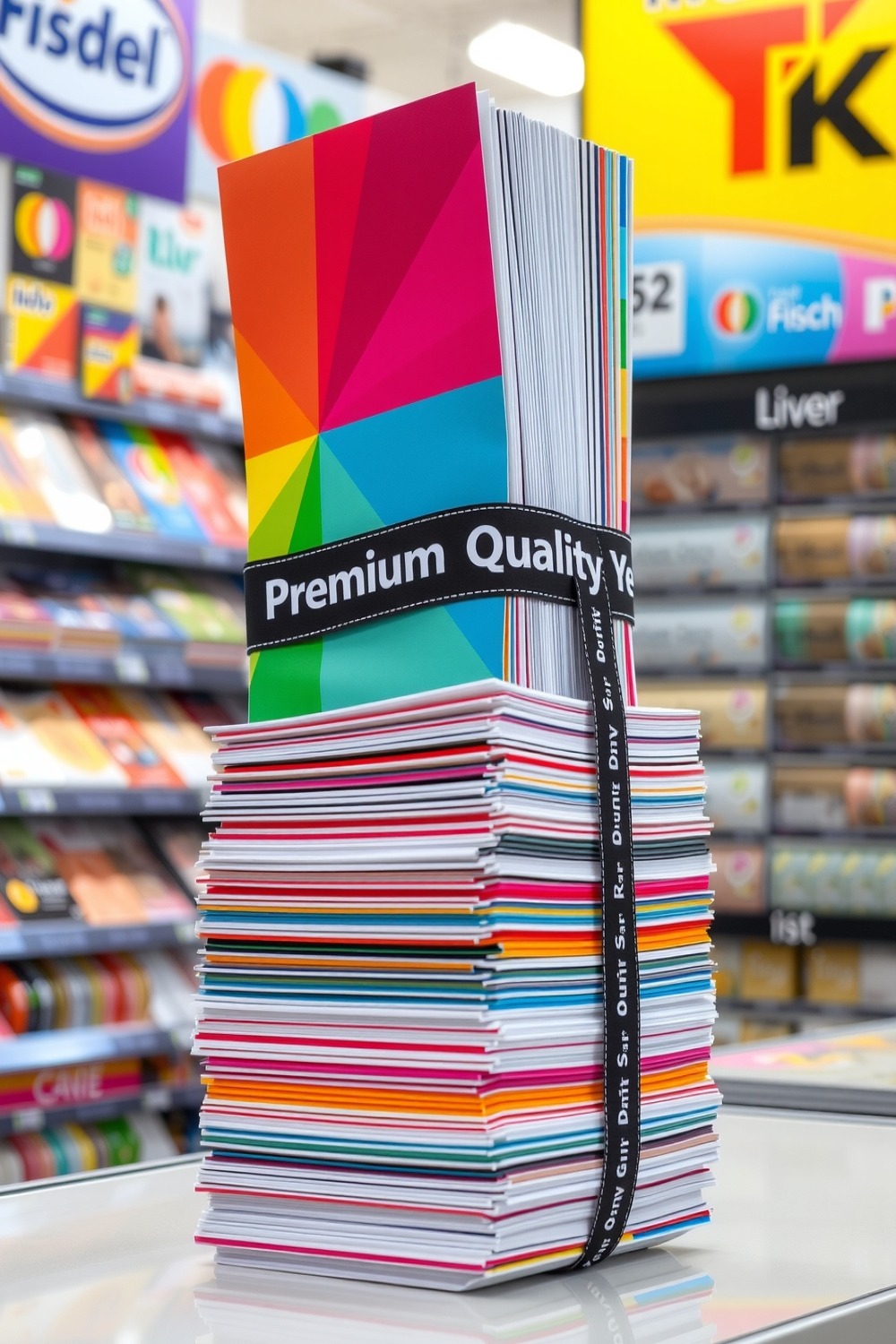
The premium standard in marketing flyer printing. At 14 typographic points thick, this cardstock is rigid enough to stand independently in a stack without curling — it will not bend under normal handling and its corners remain crisp even after extended distribution. The weight communicates premium quality instantly through touch. Used for: luxury real estate property sheets, premium restaurant menus, high-end event invitations, executive services marketing, and any campaign where the physical quality of the piece is a deliberate brand statement.
Best for: Premium brands, luxury real estate, high-touch client presentations, VIP events.
Silk paper occupies the middle ground between UV gloss and flat matte. Its semi-gloss coating produces a subtle, low-intensity sheen that reduces glare compared to full UV gloss while maintaining better color saturation than uncoated matte. The soft luster makes it particularly effective for photography-rich designs intended for viewing in office lighting — reducing the harshness of gloss reflections while preserving photographic vibrancy. Less commonly specified than gloss or matte but an excellent compromise choice.
Best for: Mixed photography and text-heavy designs in office viewing environments. Corporate with visual elements.
Kraft paper is characterized by its natural brown or off-white color derived from minimally processed wood pulp. When CMYK is printed on kraft, all colors inherit a warm, aged quality due to the base paper color — blues become teal-brown, whites become cream, blacks remain strong. The resulting aesthetic is artisanal, honest, and organic — effectively communicating values like sustainability, craft, and natural ingredients. Perfect for: natural food brands, craft beer and spirits, organic products, boutique artisan businesses, and heritage brands. Not suitable for any campaign requiring precise color accuracy or maximum vibrancy.
Best for: Natural brands, craft businesses, organic products, artisan food and beverage.
Answer two quick questions to get your best paper type match for your specific marketing scenario.
Quick-Reference Comparison Table
| Paper Type | GSM | Coating | Color Vibrancy | Best Use Case | Cost Tier |
|---|---|---|---|---|---|
| 100lb Gloss Book | 150gsm | UV Gloss | ⭐⭐⭐⭐⭐ | General marketing | Standard |
| 100lb Matte Cover | 150gsm | None | ⭐⭐⭐ | Corporate / text | Standard |
| 80lb Gloss Text | 120gsm | Aqueous | ⭐⭐⭐⭐ | High-volume economy | Economy |
| 14pt Cardstock | 235gsm | UV Gloss or Matte | ⭐⭐⭐⭐⭐ | Premium campaigns | Premium |
| Silk / Satin | 150gsm | Semi-Gloss | ⭐⭐⭐⭐ | Mixed content | Standard+ |
| Kraft Natural | Varies | None | ⭐⭐ (warm/muted) | Artisan / organic | Specialty |
Specialty Paper Types for Niche Marketing
Beyond the main categories, several specialty stock options serve specific niche marketing purposes:
- Synthetic / Waterproof Paper: Polyester-based synthetic paper is 100% waterproof, tear-resistant, and extremely durable. Used for outdoor menus, pool and spa marketing, marine business promotion, and any campaign where water exposure is guaranteed. More expensive than standard stocks but outlasts paper in appropriate contexts.
- Recycled Paper: Post-consumer recycled content papers certified by FSC (Forest Stewardship Council) or SFI standards are available for environmentally conscious brand campaigns. Quality is industry-equivalent to virgin stock in most recycled content grades, with a marginal (5-15%) cost premium. Allows brands to print “Printed on recycled paper” as a sustainability messaging element.
- Linen / Laid Texture: Textured papers with fine linear patterns embossed into the surface for a distinctive tactile quality. Used for premium brand programs where the paper itself is part of the brand identity experience. Reduces color reproduction precision but adds significant sensory differentiation.

Matching Paper Type to Marketing Message
This concept — the paper carrying part of the marketing message — is underappreciated but well-documented in brand perception research. Papers communicate:
- UV Gloss: “We are modern, vibrant, confident, and professional.”
- Matte: “We are sophisticated, trustworthy, principled, and measured.”
- 14pt Cardstock: “We invest in quality. Our standards are premium. We do not cut corners.”
- Kraft: “We are honest, natural, artisan, environmentally conscious, and authentic.”
- 80lb Economy: “We are accessible, volume-oriented, and reach-focused.” (Acceptable for the right context; damaging if misaligned with brand.)
Browse 6 Paper-Type Flyer Formats