


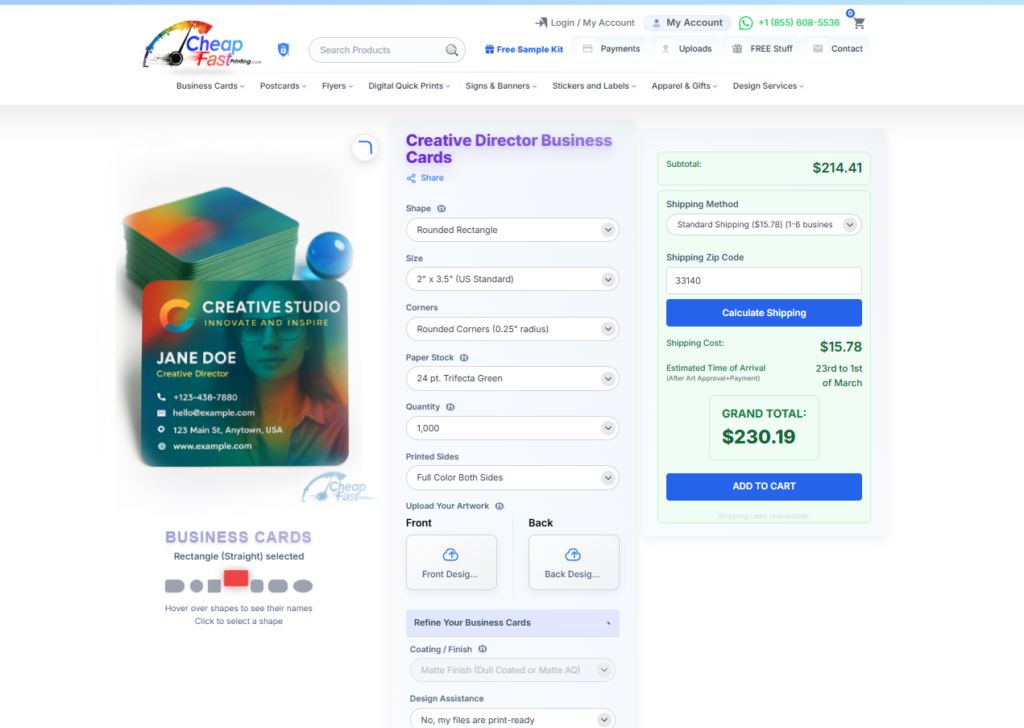
If you are a designer, photographer, illustrator, or any kind of creative professional, your business card is not just contact information. It is a sample of your work. It is evidence of your taste. It is the first thing a potential client or collaborator holds in their hands, and it needs to communicate who you are before they even read your name.
The challenge is this: most business card templates are built for corporate and professional services contexts. They are safe, clean, and a little boring. Creative professionals need something genuinely different. Something that expresses personality, shows visual sensibility, and still holds up as a professional and functional piece of print that represents you accurately in every situation where you hand it out.
We are not talking about a tiny template pack here. CheapFastPrinting.com has more than 7,000 free editable business card templates, including many styles that already lean artistic, visual, and portfolio-friendly. Start at the template hub, then browse the industry gallery or jump into pages like graphic designer business cards, product photographer business cards, illustrator business cards, and fine artist business cards. That is a much better way to gather ideas than staring at a blank rectangle trying to be original under pressure.
For a creative professional, the business card can work like a miniature portfolio sample. That means the template choice is doing more than organizing text. It is helping you signal style, confidence, niche, and material taste before anyone opens your website. That is why live visual examples matter so much here.
A stronger creative template can communicate a visual point of view in seconds, before the person even reads the name or title.
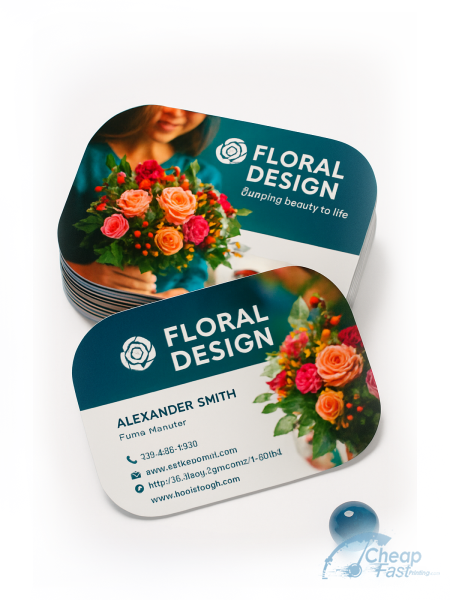
Rounded corners, square, slim, or oversized-feeling formats all create different emotional reactions, specially in creative industries.
If the base template is close, we can adapt artwork placement, text hierarchy, and QR flow so the card feels more custom without the cost of starting over.
Why Creatives Need a Different Kind of Business Card
Think about the last time you got a business card from a designer or photographer that really made an impression. Chances are it was not a standard white card with black text. It probably had something about it: an unexpected use of color, a beautiful typeface choice, an image that stopped you, or a paper stock that felt incredible in your hand. That is what creative business cards do at their best. They function as a portfolio piece in miniature.
They make an argument for your aesthetic before a word is spoken. And in a creative field where everyone has a website, an Instagram, a portfolio on Behance, a genuinely great physical card is still one of the most memorable impressions you can leave. It exists in the physical world in a way that a website link does not, and for creative professionals whose work is ultimately about the physical experience of things, that matters enormously.
How Your Card Becomes Part of Your Portfolio
The most effective creative business cards treat both sides of the card as intentional design space. The front does the contact information work clearly and professionally. The back shows off something: a piece of illustration, a bold typographic treatment, a photographic sample, a pattern, a color field that demonstrates your palette.
Every design choice you make on that card, from font selection to paper finish to the coating you use, demonstrates your design thinking. Clients who are hiring creative professionals are paying close attention to exactly these details, even when they cannot articulate what they are noticing. They are looking for someone whose judgment they can trust with their brand, and your business card is the first test of that judgment.
Best Business Card Styles by Creative Profession
| Creative Type | Ideal Card Style | Best Paper Stock | Best Finish | Key Visual Element |
|---|---|---|---|---|
| Graphic Designer | Bold typographic layout, strong visual hierarchy | 16pt Matte | Soft Touch or Spot UV | Strong typeface as the hero element |
| Photographer | Minimal front, full-bleed portfolio photo on back | 16pt Gloss or Silk | Gloss or Silk Laminate | Portfolio image showcasing your style |
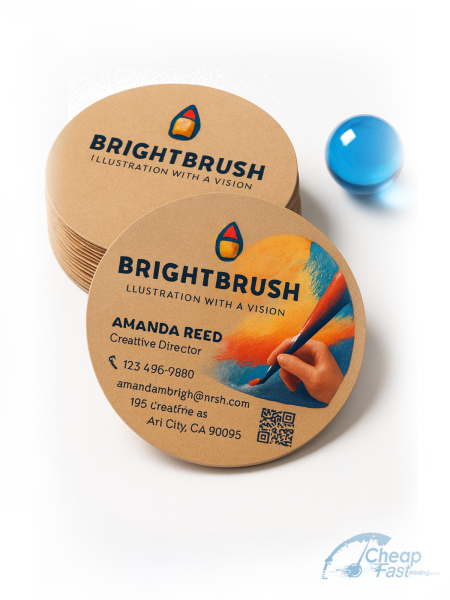
| Illustrator / Artist | Custom artwork as background or back | 16pt Matte | Soft Touch Matte | Original art, vibrant signature palette |
| Architect / Interior Designer | Clean geometric lines, spatial composition | 16pt Uncoated | Matte or Uncoated | Structural line work or spatial diagram |
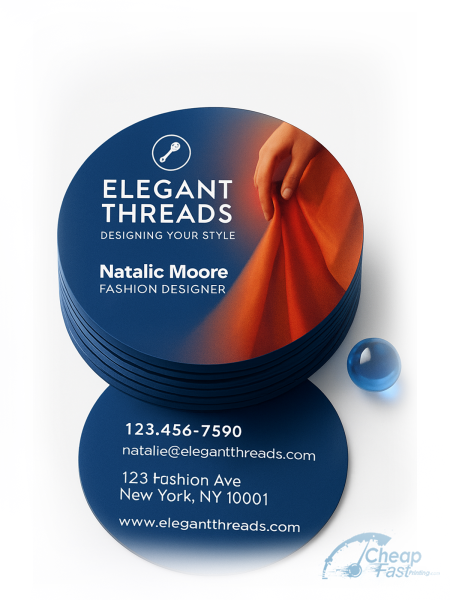
| Fashion / Stylist | Elegant, editorial, refined | 16pt Silk or Soft Touch | Silk Laminate or Foil accent | Clean typography with strong brand palette |
| Web / UX Designer | Modern, screen-inspired but with physical presence | 16pt Matte | Spot UV on key element | Interface-inspired layout elements |
| Videographer / Director | Cinematic, dramatic, high contrast | 16pt Matte or Soft Touch | Matte + Spot UV | Film-inspired aesthetic, dark backgrounds |
| Brand / Identity Designer | The card itself as a brand demo | 16pt Soft Touch | Spot UV or Foil | Complete brand system demonstrated on card |
Templates for Graphic Designers: Bold and Typographic
Graphic designers often lean into strong typographic treatments as their card’s main visual statement. An oversized name in a distinctive typeface, a clever use of negative space, or a geometric abstraction of their logo can all work brilliantly. Color is key here: designers tend to use their brand palette with confidence, often going bold where other professionals would play safe.
For paper stock, many designers choose 16pt matte or Soft Touch laminate. The velvety, tactile finish of Soft Touch is something people always comment on when they touch it, and that reaction is exactly what a designer wants when they hand out their card. It says “premium” before you even look at the design. We leverage from our State-of-the-Art finishing equipment to offer Soft Touch laminate as a standard option, and the results are genuinely impressive.
Templates for Photographers: Minimal with Strong Imagery
Photographers have an obvious and powerful asset: their actual photographs. The best photographer business card templates use a clean, minimal layout on the front for contact info and reserve the back for a striking full-bleed image from their portfolio. This is the most direct possible argument for hiring someone: here is what I make, contact me if you want more of it.
The key to a great photographer card is choosing the right image. It should represent your signature style completely and immediately. A wedding photographer should use a beautiful, romantic image. A commercial photographer should use something clean and conceptually bold. A street photographer should use an image that captures their documentary eye. The image must do the selling entirely on its own, before the person even reads your name.
For paper stock, gloss or silk laminate makes photos pop with incredible vibrancy and depth. The sheen amplifies color saturation and makes images look luminous in a way that matte or uncoated stock cannot match. If you shoot color work, gloss is almost always the right choice. If you shoot primarily black and white or moody, toned work, matte can actually be more appropriate to the aesthetic.
Templates for Illustrators and Artists: Colorful and Textured
Illustrators and artists have the most creative freedom of any professional group and should use it fully. Cards that feature original artwork on one or both sides are completely on-brand for a working illustrator. Bright, saturated color palettes, hand-drawn elements, pattern backgrounds, watercolor textures, geometric illustrations: all of these can work brilliantly when executed with intention.
The challenge for heavily illustrated cards is color accuracy in print. This is where CMYK calibration really matters. What looks vivid on screen needs to translate to ink on paper stock accurately. Our team at CheapFastPrinting.com checks and calibrates color files as part of our Free Setup process, so your illustrated cards come out looking exactly as intended, not darker or more muted than you designed them.
How to Use Your Own Artwork as the Card Background
3.75″ x 2.25″ (including bleed) at 300dpi minimum. Do not reduce resolution to make the file smaller. Print quality depends on this.
The outer 0.125″ on each side will be trimmed off. Important elements in your artwork should stay at least 0.25″ from the final edge to be safe.
You need enough contrast between your artwork and the text overlay. A semi-transparent dark band, a solid colored section, or a light area in the artwork all work.
At 100% zoom, check that your name and contact details are clearly readable against the artwork background. If you need to squint, the contrast is insufficient.
Our team can place your contact information over your artwork in the most aesthetically harmonious way, completely free. We do this kind of work every day.
Where to Find the Best Creative Card Templates
For creative business card templates that actually look creative (not just corporate templates with a colorful accent), the best sources are design-forward marketplaces where independent designers sell their work directly.
| Source | Style Focus | Price Range | Skill Needed to Edit | Standout Feature |
|---|---|---|---|---|
| Creative Market | All styles, designer-made originals | $6-$20 | Moderate (Illustrator or Photoshop) | True originals, not mass-produced templates |
| Etsy | Hand-lettered, artisan, botanical | $3-$12 | Low (many Canva options) | Unique styles not found elsewhere |
| Dribbble | Cutting-edge, experimental concepts | Free-Premium | High | Latest design trends, inspiring concepts |
| Behance | Student to professional range | Mostly free | Moderate-High | Wide range, many unique concepts |
| Envato Elements | All styles, volume library | $16/mo unlimited | Moderate | Unlimited downloads for regular users |
| CheapFastPrinting.com | Custom designed for you | Free | Zero needed | Your brief, our designers, your card |
Printing Tips for Visually Intense Creative Cards
Creative cards with bold colors, full-bleed photography, or heavy illustrations need a little extra attention at the printing stage. Here is what experienced designers know that beginners often miss:
- Dark or saturated backgrounds: Always request a printed proof or small test run before committing to a large quantity.
- Full-bleed photography: Image must extend completely into bleed area, 0.125″ beyond card edge on all four sides.
- Foil or Spot UV accents: Requires a separate file layer indicating foil/UV areas. Our team handles this setup at no charge.
- Very bright colors: CMYK has a smaller gamut than RGB screens. Our team previews color accuracy before printing.
- Recommended stock for creatives: 16pt Soft Touch or Matte laminate. Holds color beautifully and feels genuinely premium.
One more thing worth saying: for creative professionals, the paper stock and finish you choose is as much a creative decision as the design itself. A photographer who chooses 16pt gloss is making a different statement than one who chooses 16pt matte. An illustrator who chooses Soft Touch velvet laminate communicates something about their aesthetic sensibility before the card is even turned over to look at the design. Make this choice consciously.
| Item | |
|---|---|
| ☐ | Artwork file is 300dpi at 3.75″ x 2.25″ (including bleed) |
| ☐ | All critical design elements are at least 0.25″ from the final trim edge |
| ☐ | Text has sufficient contrast against background artwork or color |
| ☐ | Contact information is readable at actual 100% print size |
| ☐ | Foil or Spot UV areas are on a separate layer (if applicable) |
| ☐ | Color mode is CMYK (or flagged for free conversion by CheapFastPrinting.com) |
| ☐ | Both front and back designs are included and clearly labeled |
| ☐ | Paper stock and finish have been selected to match brand aesthetic |
| ☐ | Digital proof has been reviewed at actual card size, not just full screen |