

Choosing the wrong flyer size is a costly and entirely avoidable mistake. Too large and your distribution costs increase for no additional conversion benefit. Too small and you can’t fit the content your campaign requires. The ideal flyer size is the intersection of your content requirements, distribution context, audience behavior, and budget — and that intersection is different for every campaign.
This guide covers every standard US flyer size in complete detail: the actual dimensions, the number of units per press sheet (which determines your cost), the appropriate use cases, and the scenarios where each size format excels and where it does not. By the end, you will be able to select the ideal size for any campaign with complete confidence.
Flyer Size Visual Comparison (Click Each to Explore)
Answer 3 questions to get your optimal flyer size recommendation instantly.

All Standard Flyer Sizes Compared
| Size | Dimensions | Area | Units/Sheet | Mail Type | Best Use |
|---|---|---|---|---|---|
| Quarter Sheet | 4.25×5.5″ | 23.4 sq in | 4 per sheet | Postcard | Economy events, retail |
| Postcard 4×6 | 4×6″ | 24 sq in | 4 per sheet | Postcard rate | Direct mail, minimal offers |
| 5×7 Card | 5×7″ | 35 sq in | 2 per sheet | Postcard std | Premium event cards |
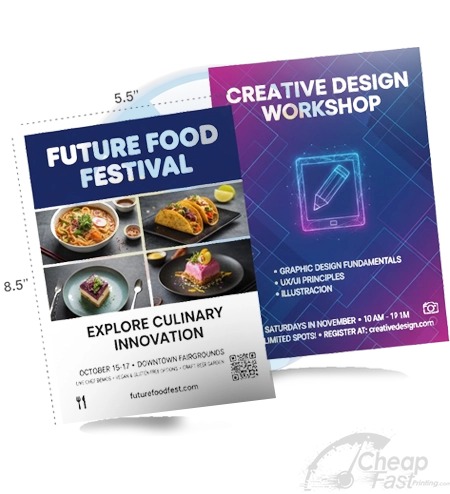
| Half Sheet | 5.5×8.5″ | 46.75 sq in | 2 per sheet | Letter rate | Most versatile — balanced spec |
| Rack Card | 4×9″ | 36 sq in | Custom | Letter rate | Lobby display, countertop rack |
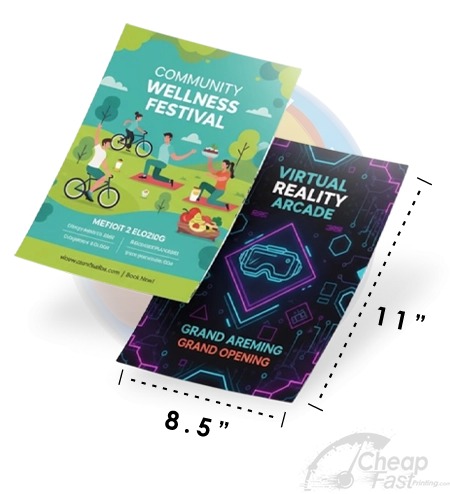
| Full Sheet | 8.5×11″ | 93.5 sq in | 1 per sheet | Flat rate | Detailed campaigns, B2B |
| Legal Sheet | 8.5×14″ | 119 sq in | 1 per sheet | Large flat | Extended content, menus |
Size vs Cost: Understanding Per-Unit Pricing
The cost of flyer printing is primarily driven by the number of units that fit on a single press sheet — a concept called imposition. A press operator loads a large parent sheet (typically 26×40 inches for commercial offset) and prints multiple flyer images per sheet. The more images per sheet, the lower the cost per finished flyer.
- 4.25×5.5 (Quarter Sheet): 4 units per 8.5×11 equivalent → approximately 70-75% less expensive per unit than a full-sheet equivalent at the same paper spec.
- 5.5×8.5 (Half Sheet): 2 units per 8.5×11 → approximately 40-50% less expensive per unit than a full sheet.
- 8.5×11 (Full Sheet): 1 unit per press equivalent → baseline pricing. All other sizes priced relative to this.
This press sheet economics logic makes smaller formats dramatically more cost-efficient per unit — which is why high-volume event distributors instinctively reach for quarter-sheet handbills over full-sheet flyers for maximum quantity within a fixed budget.
Best Size by Specific Use Case
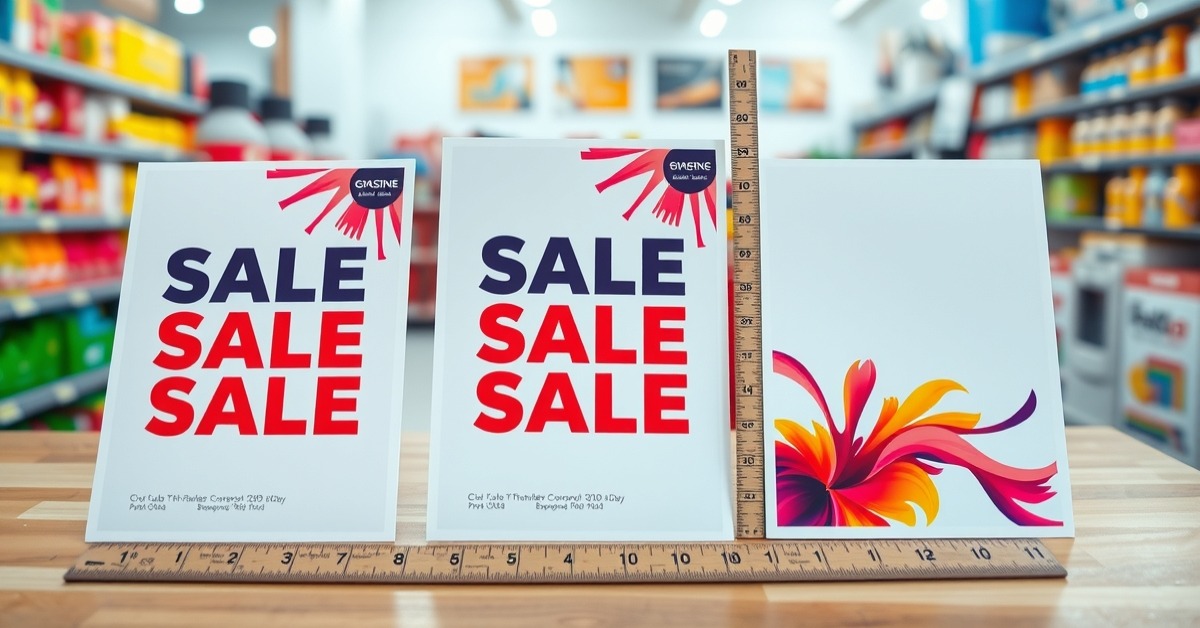
- Restaurant promotions (handout): 4×6 or 4.25×5.5 — compact for pocket, full-color photo front
- Concert/event promotion (street distribution): 5.5×8.5 — enough visual space for event graphic, date, lineup, and QR code
- Real estate open house: 5.5×8.5 or 8.5×11 in portrait — property photo dominant, address, features list
- USPS direct mail campaign: 4×6 on 14pt for postcard rate — the cheapest mail format
- Lobby display rack: 4×9 rack card — the universal display rack standard worldwide
- Trade show table handout: 5.5×8.5 or 8.5×11 — content space needed for product/service detail
- Church/school announcement: 5.5×8.5 half sheet — friendly, readable, economical
- Retail grand opening: 5.5×8.5 with UV gloss — vivid design at high volume economy pricing
Browse 6 Size-Specific Flyer Formats