


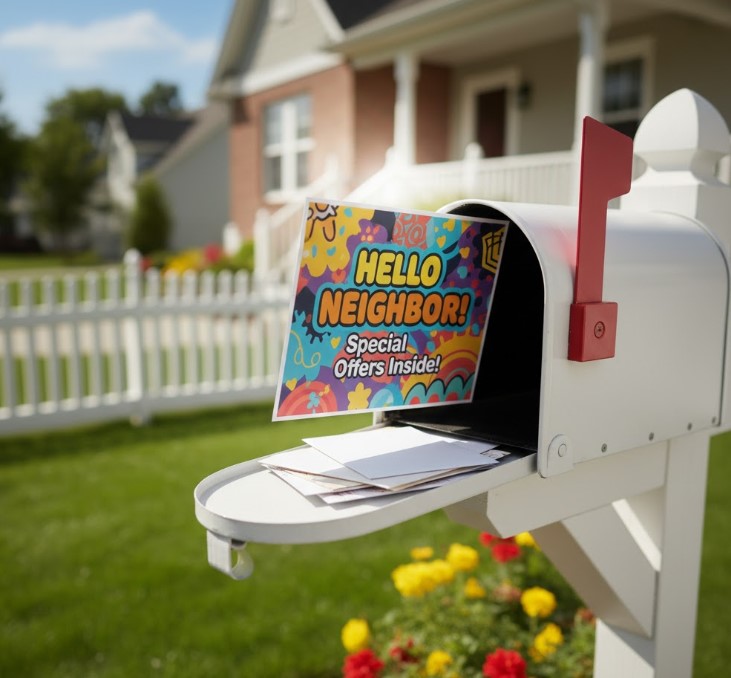
Every piece of mail that lands in a customer’s mailbox competes for attention. In a typical residential mailbox, your EDDM (Every Door Direct Mail) piece sits alongside utility bills, advertisements, and catalogs. The size of your mailer isn’t just a technical specification, it’s a visibility strategy. Understanding EDDM mailing size requirements isn’t about following rules for the sake of compliance, it’s about maximizing the impact your marketing piece has when it arrives at the doorstep.
The most common question we hear from businesses planning their first EDDM campaign is straightforward: “What size should I print?” The answer involves balancing postal regulations, mailbox physics, printing costs, and marketing effectiveness. This guide walks you through everything you need to know.
Why EDDM Mailing Size Requirements Exist
EDDM size requirements aren’t arbitrary restrictions created by bureaucracy. They exist for practical reasons rooted in how modern mail processing works and how mailboxes function in the real world.
The United States Postal Service (USPS) established these requirements to ensure every piece of mail can be sorted, transported, and delivered efficiently across the nation’s mail distribution network. Your marketing piece, whether it’s a postcard or a large flat, must pass through dozens of sorting facilities, automated machines, and delivery vehicles before reaching your target audience. Every step of this journey depends on your mailer fitting within specific parameters.
Machine Compatibility and Sorting
Modern USPS facilities rely heavily on automated sorting machines that read addresses and barcodes at incredible speeds. These machines have physical dimensions and tolerances. If your mailer is too small, the machines can’t grip it properly during scanning. If it’s too large, it jams the processing equipment or gets routed to manual sorting, which delays delivery and increases your costs.
The EDDM program specifically targets “Marketing Mail” flats, which have distinct size parameters. The minimum size is 6 inches wide by 9 inches tall. The maximum size is 11.5 inches wide by 15.5 inches tall. These boundaries weren’t chosen randomly, they’re based on exactly what the sorting equipment can handle reliably. Staying within these dimensions ensures your mail moves through the system smoothly, arrives on schedule, and doesn’t create bottlenecks that frustrate postal workers.
When you print outside these specifications, you risk your mailers being rejected at the post office or subject to additional fees. More importantly, you might face delays that make your time-sensitive marketing campaign miss its window.
Maximizing “Desk Real Estate” in the Home
Beyond the postal machinery, there’s another critical dimension to size requirements: the human element. Most people sort their mail while standing over a trash can or at their kitchen counter. They have seconds, not minutes, to decide whether your piece is worth keeping or worth discarding.
This is where the visual battle begins. Your EDDM mailer is competing for what we call “desk real estate,” the limited space on someone’s kitchen counter or desk where mail accumulates. Smaller pieces get buried. Larger pieces command attention.
Bigger Sizes Get Read First
Research into mail behavior shows that larger pieces have a higher engagement rate because they’re simply harder to overlook. A 6.25 by 9 inch postcard sits naturally in someone’s hand. An 11 by 6 inch panoramic mailer takes up more visual space and creates an impression of importance or urgency. When recipients see a larger piece arriving in their mailbox, they notice it first.
This doesn’t mean bigger is always better, but within the EDDM size specifications, choosing the right dimensions can improve response rates. A mailer that fills someone’s hand and demands attention from inside the mailbox is more likely to be examined before being discarded.
The aspect ratio matters too. A square shape feels different than a horizontal rectangle. A tall vertical format catches the eye differently than a landscape orientation. These aren’t just aesthetic preferences, they’re behavioral triggers that affect how your mail gets handled and whether it gets read.
The Price vs Size Paradox
Here’s something that surprises most business owners planning their first EDDM campaign: printing larger isn’t significantly more expensive when you understand how print production costs work.
When your printing company produces your mailers, the cost structure is primarily determined by paper stock, ink coverage, and setup time, not the finished dimensions. Printing one hundred 6.25 by 9 inch postcards costs nearly the same per unit as printing one hundred larger 6 by 11 inch mailers because the production process is fundamentally the same.
Cheap Printing for Massive Sizes
The printing industry works on economies of scale and production efficiency. Once your printer has set up the press, prepared the ink, and loaded the paper, the marginal cost of printing a larger piece in the same print run is minimal. This is why EDDM printing remains affordable even at larger dimensions.
You might pay slightly more for heavier paper stocks or specialty finishes at larger sizes, but the base cost of printing a panoramic 6 by 11 format is competitive with smaller options. This means you can dramatically increase your visual impact in the mailbox without dramatically increasing your printing budget.
Many businesses underestimate this aspect of EDDM cost structure. They assume that bigger automatically means more expensive, so they default to the smallest allowed dimensions. In reality, you might gain significant marketing advantage for just a few dollars more per thousand pieces printed.
Does Size Affect Postage Cost? (Spoiler: No)
This is the feature that makes EDDM so attractive for direct mail marketing. EDDM postage is calculated on a per piece basis, not based on the size of your mailer. Whether you mail a 6 by 9 postcard or an 11.5 by 15.5 inch flat, the postage rate is identical as long as both fall within the EDDM specifications and weigh under the weight threshold.
The only postal cost variable that matters is weight. Paper stock that’s heavier might push you into a higher postage rate, but the dimensions themselves don’t trigger additional fees. This is fundamentally different from other mailing programs where size and weight directly correlate to cost. With EDDM, you’re not penalized for choosing a larger format within the allowable range.
This pricing structure removes a major barrier to implementing a high-impact visual strategy. You can maximize visibility and engagement in the mailbox without worrying that you’re exceeding your marketing budget.
Our Top Recommended Sizes for ROI
After working with thousands of EDDM campaigns, several size formats have emerged as particularly effective for return on investment. These aren’t the only options available, but they represent the sweet spot between postal specifications, mailbox impact, and production efficiency.
The “Standard” 6.25″ x 9″
The 6.25 by 9 inch format is the workhorse of EDDM campaigns. This size is sometimes called a postcard format, though it’s not technically a postcard when used for EDDM purposes, it’s classified as a flat. This dimension fits comfortably in someone’s hand and in standard mailbox openings. Designs in this format feel natural and balanced.
The 6.25 by 9 inch size has another advantage: it’s the most commonly ordered format, which means printing companies have optimized production workflows around this dimension. This can sometimes result in the fastest turnaround times and most competitive pricing.
The aspect ratio of this size works well for most marketing messages. You have enough space to include product photos, compelling copy, and a clear call to action without the design feeling cramped. The standard postcard orientation has been proven effective for everything from restaurant promotions to real estate marketing to service business offers.
The “Panoramic” 6″ x 11″
The 6 by 11 inch panoramic format is becoming increasingly popular with sophisticated EDDM marketers. This wider format creates a dramatic visual presence in the mailbox. When recipients open their mailbox and see a piece that’s wider than it is tall, it naturally draws the eye.
The panoramic aspect ratio works particularly well for image-focused marketing. If you’re showcasing a product, a location, or an experience, the wider format gives you more horizontal space to tell that visual story. Real estate agents love this format for neighborhood showcases. Home service businesses use it to display before and after photos. Hospitality brands use the panoramic format to create an immersive preview of their locations.
The panoramic format sits at an interesting point in the EDDM specification range. It’s not as universally produced as the 6.25 by 9, but it’s not so unusual that it creates production complications or delays. You get a differentiated mailbox presence without any significant trade offs in cost or delivery time.
We Ensure Your Mail Fits the Rules
Working with an experienced EDDM printing partner ensures that your marketing vision gets executed correctly within all postal specifications. Size isn’t something to guess about or estimate based on what sounds reasonable.
Every piece matters. If even a handful of your mailers fall outside EDDM specifications, you might face rejection at the post office or variable handling that affects delivery dates. Professional print partners have templates, design specifications, and verification processes that ensure compliance before a single piece prints.
When you order EDDM mailers, your design template should be precisely sized to the specifications you’ve chosen, with appropriate bleed areas and safe zones for critical design elements. Your printing company should verify that your artwork meets EDDM requirements and that your final mailers will meet USPS tolerances for size and weight.
Beyond just printing correctly sized mailers, a good EDDM partner helps you select the right size for your specific marketing goals. They understand how different formats perform in the market, which dimensions work best for different industries, and how to maximize your response rates within your budget.
Your EDDM campaign’s success depends on much more than just mailing pieces that comply with regulations. It depends on pieces that command attention, communicate your message clearly, and inspire action. Size is just one element of that equation, but it’s one you shouldn’t underestimate.
The dimensions you choose for your EDDM mailer set the stage for everything else your design needs to accomplish. Make that stage as impactful as possible.

Resources: https://www.usps.com/business/every-door-direct-mail.htm