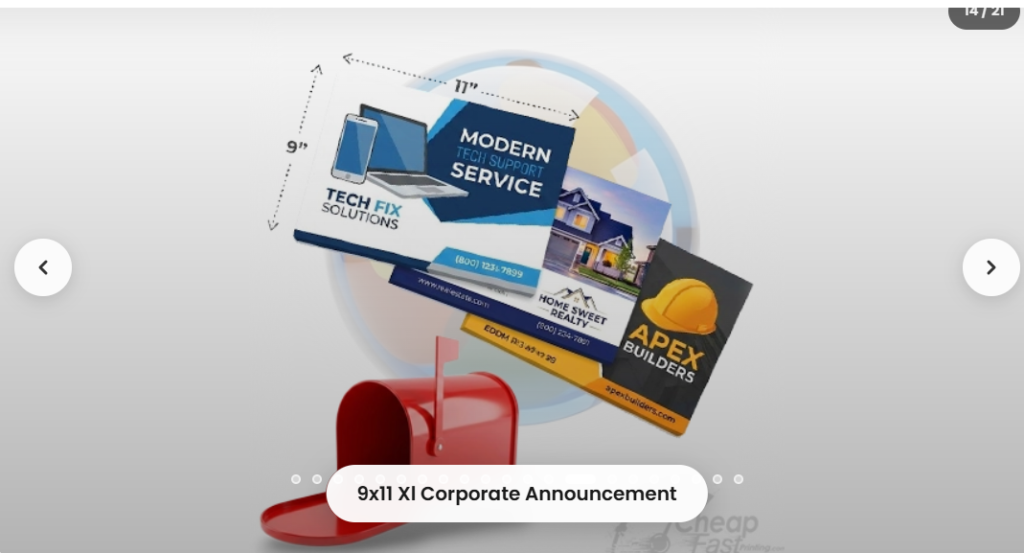


Imagine standing at the post office counter with a heavy box of 5,000 freshly printed postcards in your arms, only to hear the clerk say, “We can’t accept these.”
It happens more often than you think. The difference between a successful local marketing campaign and a recycling bin full of wasted paper often comes down to a fraction of an inch. Understanding strict eddm size requirements is not just a suggestion, it is a rigid mechanical standard set by the high-speed machines that process the mail.
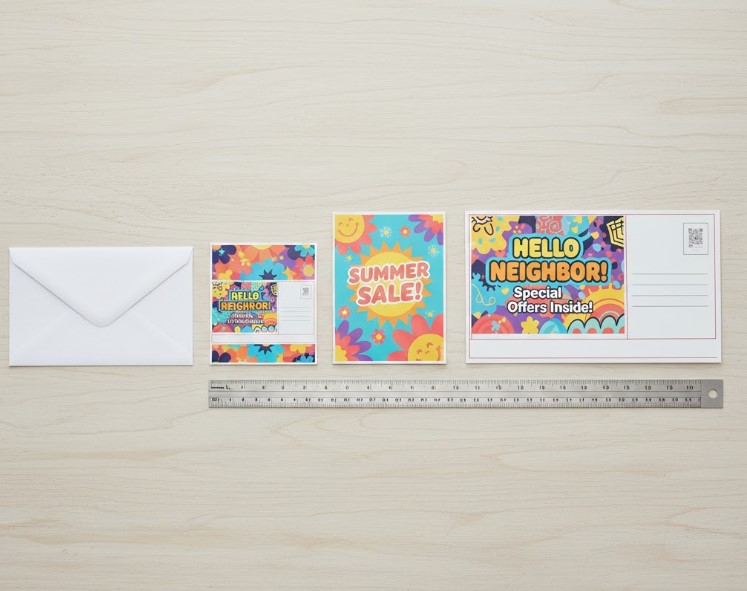
We see this confusion daily. Business owners often assume a standard postcard works for everything, yet Every Door Direct Mail is a unique beast. To qualify for those incredibly low postage rates, your mailer must physically qualify as a “flat” rather than a “letter.” If you miss the mark by even an eighth of an inch, your postage costs could triple, or worse, your mail could be rejected entirely.
We wrote this guide to ensure that never happens to you. By sticking to the safe, proven dimensions we outline below, you can design with total confidence.
The Golden Rule of EDDM Size Requirements
The United States Postal Service (USPS) does not use human judgment to sort mail at the primary stages, they use high-speed automated equipment. For your mail piece to be processed as a “flat” and qualify for EDDM Retail rates, it must physically exceed the dimensions of a standard letter.
This is the core concept you must memorize. If your mailpiece looks like a standard letter, fits in a standard envelope, or feels like a standard card, it likely fails the EDDM size test. To pass, your mailer must be flexible, uniformly thick, and rectangular.
But “rectangular” is just the start. The specific dimensions are where the safety lies, and this is where most errors occur. The rule is based on the concept of exclusion: your mailer must be too big to fit into the machine that sorts standard letters.
Longer Than 11.5″ OR Higher Than 6.125″
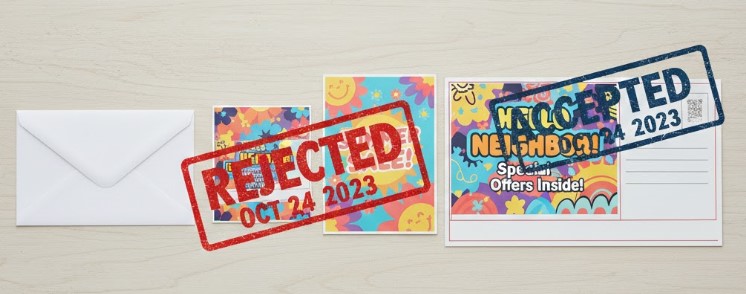
This is the technical threshold that separates a Letter from a Flat. To qualify for EDDM Retail, your mailpiece must meet one specific criterion to differentiate it from a standard letter.
The rule is often misunderstood, so let’s clarify it. A standard letter is defined as being up to 11.5 inches long and up to 6.125 inches high. Therefore, to be a Flat, you generally want to exceed these maximum letter dimensions in at least one direction.
Specifically, the USPS requires that an EDDM mailpiece must have:
- A length greater than 10.5 inches, OR
- A height greater than 6.125 inches, OR
- A thickness greater than 0.25 inches (which is very rare for postcards).
Ideally, you should not try to skirt the line with weird custom fractions. We recommend sticking to standard sizes that clearly blow past these minimums. If you try to print a card that is exactly 6.125 inches high, a cutting error of 1/16th of an inch could disqualify your entire mailing. Always leave a safety margin to ensure your investment is safe.
Why Standard 4×6 Postcards Don’t Qualify
This is the single most common mistake we see rookies make. You are likely used to mailing 4″ x 6″ postcards with a stamp to friends or family. You assume you can just print 5,000 of them and hand them to the post office for the EDDM rate. You cannot.
A 4″ x 6″ postcard is classified as a “Letter.” The machines that sort letters are entirely different from the machines that sort EDDM flats. If you put a 4″ x 6″ card into the EDDM stream, the equipment literally cannot handle it in the same batch. The postage rate for EDDM is essentially a bulk discount for helping the USPS bypass the letter sorting machines and handing the “flats” directly to the carrier.
The Definition of a USPS “Flat”
To understand why small cards are rejected, we have to look at the “Flat” definition. In the eyes of the post office, a “Flat” is a large, flexible envelope, magazine, or oversized card. EDDM is exclusively a service for Marketing Mail Flats.
When you use a small card, you are effectively asking for “First Class Postcard” service or standard “Marketing Letter” service, both of which require specific addressing on every single piece. You would need a mailing list, a permit, and specific presorting.
EDDM avoids all that work specifically because the mailers are large enough to be bundled and handed directly to the carrier for manual distribution along a route. Small cards get lost in the shuffle, while large flats are easy to hold and deliver.
For authoritative details on these physical standards, you can reference the official USPS EDDM User Guide.
Popular Sizes That Always Work
While you can create custom sizes that fit the criteria, we almost always recommend sticking to the industry standards. Why reinvent the wheel when certain sizes are proven to work and are familiar to your local post office?
Standard sizes are also more cost-effective to print. They fit efficiently on large parent sheets of paper, reducing waste and lowering your price per piece. Here are the two undisputed champions of the EDDM world.
The 6.5″ x 9″: The Budget Friendly Choice
If you are looking for the most affordable entry point into EDDM, the 6.5″ x 9″ is your best friend. It is often referred to as the “Standard EDDM Postcard” in the printing industry.
This size is perfect for two reasons. First, it clearly meets the height requirement. At 6.5 inches tall, it is safely above the 6.125-inch minimum, so the post office clerk can see at a glance that it qualifies. Second, it is compact enough to be easy to handle but large enough to stand out in the mailbox.
When you open your mailbox, a 6.5″ x 9″ card covers up almost everything else inside. It physically sits on top of standard #10 envelopes, ensuring your advertisement is the first thing the homeowner sees. It offers plenty of room for a headline, a strong offer, and a map to your location, all without feeling overwhelming or cluttered.
The 9″ x 12″: The Jumbo Dominator
If you want to absolutely dominate the mailbox, you go with the 9″ x 12″. This is the largest standard size typically used for EDDM Retail. It is massive.
Holding a 9″ x 12″ mailer feels like holding a placemat or a small billboard. It is impossible to ignore. We recommend this size for high-ticket offers such as real estate listings, roof replacements, or luxury landscaping. When the potential sale is worth thousands of dollars, spending a few extra pennies on the paper size is a smart investment.
From a design perspective, the 9″ x 12″ canvas is a luxury. You can use large, high-resolution photos without them looking cramped. You can use whitespace generously to create a premium feel. You don’t have to shrink your terms and conditions to microscopic sizes. If your brand relies on visual impact, this is the size for you.
Custom Sizes: Can You Go Rogue?
Technically, yes. You can print any size you want as long as it falls within the minimums and maximums (Max: 15″ long, 12″ high). However, going rogue comes with risks.
When you order a custom size, you often have to pay for a “custom cut” fee, or you end up paying for the waste paper that gets trimmed off the parent sheet. Furthermore, if you design a card that is barely legal—say, exactly 6.125 inches tall—you are gambling with manufacturing tolerances.
Sticking to Safe Zones for Best Results
In the printing world, we have a concept called “bleed” and “safe zones.” Because paper shifts slightly as it moves through the cutting blades, we can never guarantee a cut is accurate down to the microscopic level. There is always a variance of about 1/16th of an inch.
This is why we urge you not to design right up to the edge of the EDDM size requirements. If you aim for exactly 6.125 inches and the cutter shifts slightly inward, you might end up with a 6.1-inch card. That card is now a “Letter,” not a “Flat,” and the post office can reject it.
By choosing a 6.5-inch height, you have built in nearly half an inch of safety buffer. You could have a terrible day at the cutter and still be perfectly legal. Safety prevents stress.
Using Our Templates to Guarantee Safety
The easiest way to avoid these headaches is to use pre-made templates. We have already done the math. Our templates for 6.5×9, 8.5×11, and 9×12 include the proper bleed area (usually 0.125 inches on all sides) and the proper indicia placement.
Speaking of the indicia, proper placement of the “EDDM Retail” stamp is just as important as the physical size. It must be in the top right corner, and the font must be all caps. Using a verified template ensures you don’t accidentally put the postage mark in the “read zone” of the sorting equipment, which can cause processing delays.
Select Your Size and Print Now
Choosing the right size is the first step in a campaign that actually reaches your neighbors. Don’t let the fear of rejection stop you, just respect the machines that do the work.
In our experience, the 6.5″ x 9″ is the sweet spot for 80% of businesses. It is affordable, legal, and effective. But if you need to make a statement, upgrade to the 9″ x 12″.
Whatever you choose, ensure your file has high-resolution images and that you keep critical text away from the trim edge. Once the size is sorted, you can focus on what really matters: crafting an offer that gets the phone ringing.
Ready to get started? We can help you navigate the specs and get your mailers printed, bundled, and ready for the post office without a hitch.