

By The CheapFASTprinting Team | Updated: January 2026
You spent valuable budget printing them. You woke up early to place them. Then, two days later, they vanished. If you have ever wondered where your marketing materials went, you likely violated the local rules for placing business yard signs in neighborhoods.
For contractors, realtors, and politicians, the humble 18×24 Coroplast sign is a marketing weapon. But for city code enforcement, it is often viewed as “litter on a stick.” The difference between a high-ROI campaign and a confiscated sign usually comes down to knowing the boundaries of the “Public Right of Way.”
In this guide, we will walk you through the legalities, the strategies, and the design hacks that keep your signs in the ground and generating leads.
In This Guide:1. The “Right of Way” Trap (Where Most Fail)2. Navigating HOA & Community Restrictions3. The “Friday Night” Strategy4. Design for Distance: Compliance Meets Visibility5. Choosing Materials That Last6. Frequently Asked Questions
The “Right of Way” Trap: Understanding Public vs. Private
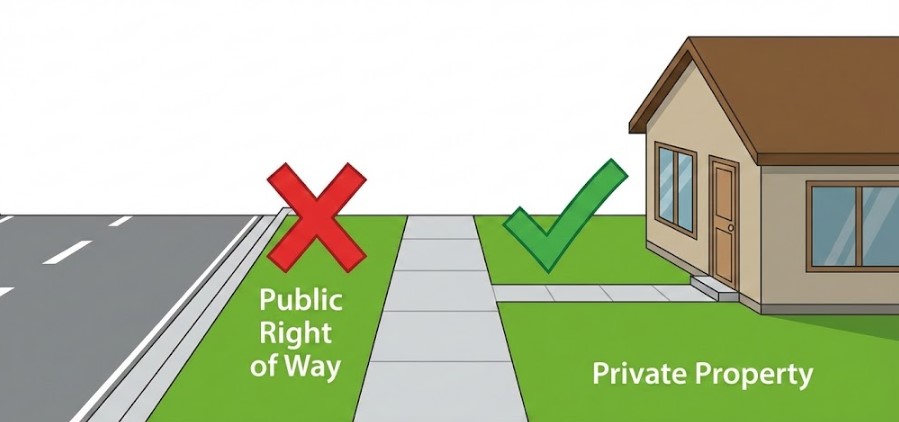
The number one reason signs get confiscated is placement in the Public Right of Way (ROW). Most business owners assume that the “yard” starts where the grass begins. Legally, this is incorrect.
In most municipalities, the city owns a strip of land extending from the curb inward—often 10 to 15 feet. This includes:
- The sidewalk itself.
- The grass strip between the sidewalk and the street (often called the “verge” or “devil’s strip”).
- Utility pole areas.
- Traffic medians and roundabouts.
When you place a sign in these areas, it is legally considered abandoned trash in many jurisdictions. Code enforcement officers are authorized to remove them without warning.
💡 The “Behind the Sidewalk” Rule: In our experience printing for thousands of local businesses, the safest placement is always behind the sidewalk on the homeowner’s side. If there is no sidewalk, measure at least 15 feet back from the curb to be safe.
Navigating HOA & Community Restrictions
Even if you are on private property, you are not always in the clear. When adhering to rules for placing business yard signs in neighborhoods, Homeowners Associations (HOAs) present the strictest challenge.
HOAs often have bylaws that supersede standard city ordinances. They may ban “commercial signage” entirely or restrict it to active working hours.
How to Get Around HOA Bans (Legally)
You cannot force an HOA to accept a generic ad. However, most HOAs allow signs for “Active Work in Progress.”
- Ask for Permission: Include a clause in your contract asking the homeowner if you can leave a sign only while the work is ongoing plus 3 days after completion.
- Reframe the Sign: Instead of a generic “We Paint Houses” sign, use a “Caution: Work in Progress – Painting by [Your Company]” sign. This frames it as a safety/advisory notice rather than pure advertising.
The “Friday Night” Strategy (Guerrilla Marketing)
Disclaimer: We are printers, not lawyers. Always check your specific local municipal codes.
There is a well-known industry practice often called “Bandit Sign Marketing.” Many business owners execute their sign campaigns based on the schedule of Code Enforcement officers.
Why it happens: In many cities, code enforcement operates Monday through Friday, 9 AM to 5 PM. The Strategy: Businesses place signs on Friday evenings (after 5 PM) and retrieve them on Sunday nights.
⚠️ Risk Assessment: While this strategy avoids immediate confiscation by city employees, it does not stop angry neighbors from removing signs they view as clutter. If you use this strategy, prioritize high-traffic intersections but keep your signs neat and respectful. Never staple signs to utility poles—this is illegal almost everywhere and creates safety hazards for utility workers.
Design for Distance: Compliance Meets Visibility
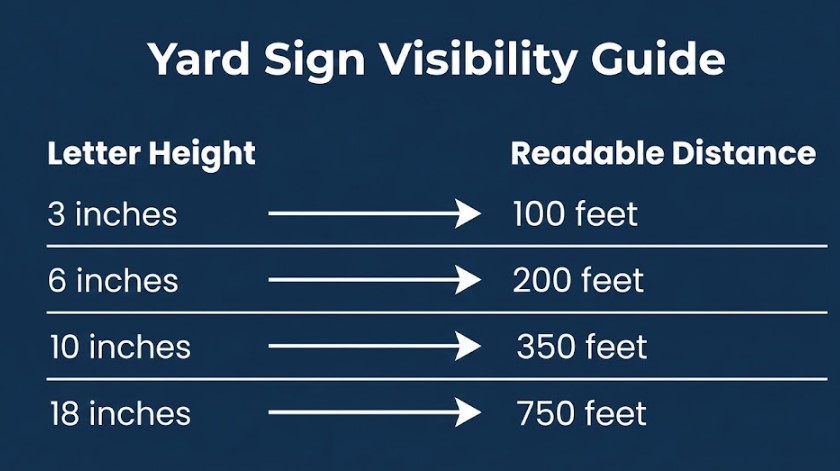
Here is the trade-off: To follow the rules for placing business yard signs in neighborhoods, you must place your sign further back from the road (outside the Right of Way). This makes the sign harder to read.
To compensate for the extra 10–15 feet of distance, your design must change. You cannot use the same layout as a business card.
The 1-Inch Rule
A general rule of thumb in the sign industry is that 1 inch of letter height = 10 feet of readable distance. If your sign is 20 feet back from the road, and a car is passing at 35 MPH, you need significant size to make an impression.
- Bad Design: “John’s Plumbing, Serving the Tri-State Area, Call 555-0199, www.johnsplumbing.com, Licensed & Insured” (Too much text, font too small).
- Good Design: “PLUMBING” (5-inch letters) + “555-0199” (4-inch numbers).
High contrast is also non-negotiable. Dark Blue text on a White background or Black text on a Yellow background offers the highest readability index.
Choosing Materials That Last
We believe that if a sign is worth placing, it is worth keeping. Nothing damages a brand image faster than a soggy, folded-over cardboard sign.
Coroplast (The Industry Standard)
For temporary outdoor signage, 4mm Corrugated Plastic (Coroplast) is the gold standard. It looks like plastic cardboard. It is waterproof, stain-resistant, and rigid enough to stand on a wire stake.
The Stakes Matter
Standard “H-Stakes” (wire frames) are cheap and effective for soft soil. However, if you are in an area with hard-packed clay or rocky soil, standard wire stakes will bend. For these environments, we recommend upgrading to “Heavy Duty” stakes or using a grommet-and-zip-tie method if a fence is available (and legal).
Frequently Asked Questions
Q: Can I put yard signs on telephone poles?
A: Almost universally, no. Utility poles are private property (owned by the utility company) or strictly regulated city property. Placing signs here is often a misdemeanor offense involving fines per sign.
Q: What is the fine for illegal signs?
A: It varies by city, but fines can range from $50 to $500 per sign. Most cities will simply confiscate/trash them first, issuing a warning before fining. However, repeat offenders are targeted.
Q: How long can I leave a sign in a client’s yard?
A: This depends on your agreement with the client and local ordinances. A safe bet is the duration of the project plus 3-5 days. Anything longer risks annoying the homeowner and the neighbors.
Win the Neighborhood Marketing Game
Now that you know the legal placement strategy, you need signs that command attention from the sidewalk. Our 18×24 Coroplast Yard Signs are printed with UV-resistant ink to ensure your message stays sharp, rain or shine. See Yard Sign Pricing & Deals